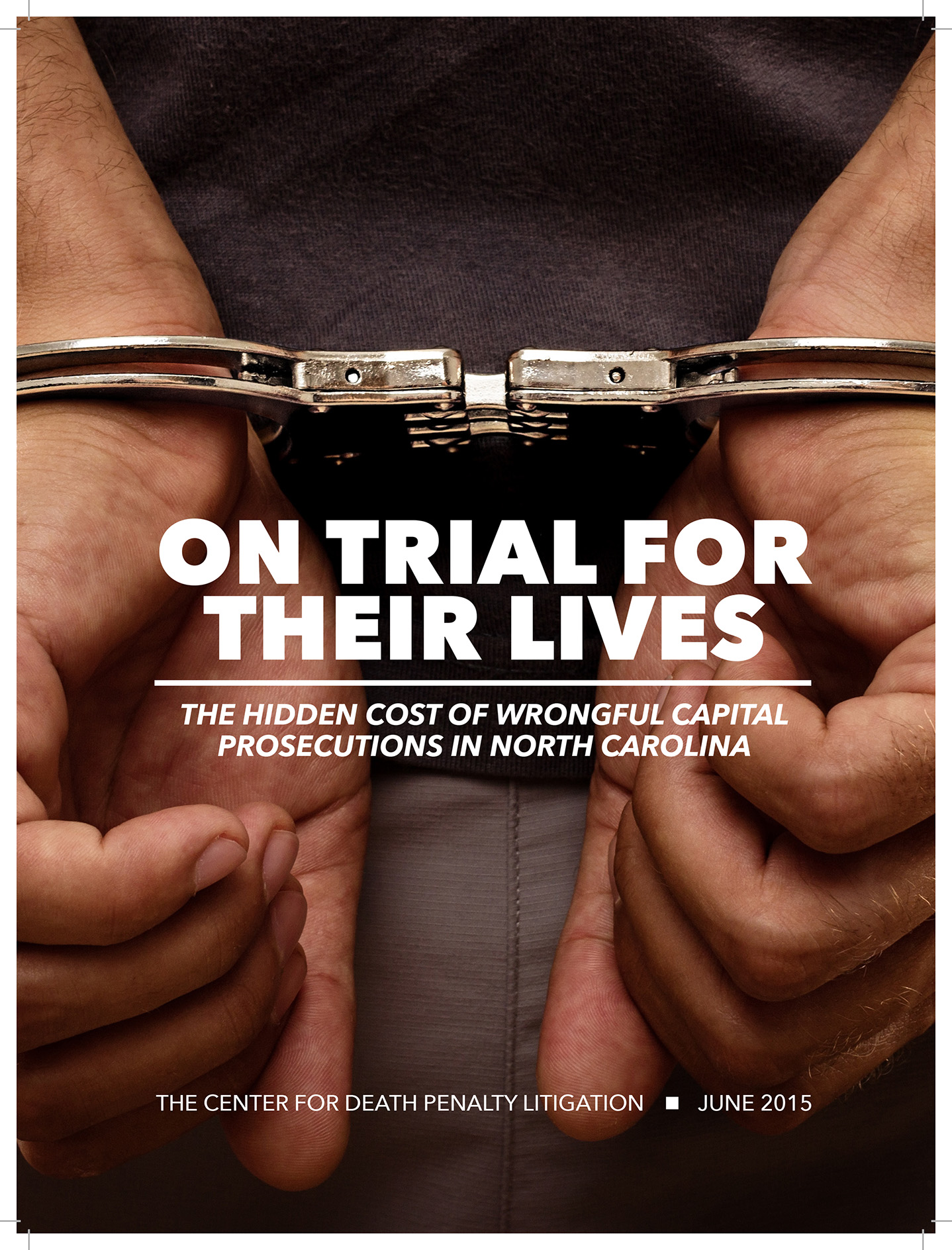
CDPL and the N.C. Coalition for Alternatives to the Death Penalty have just launched a new interactive project: On Trial for Their Lives. Much like the National Registry of Exonerations tracks the cases of people who are wrongly convicted, this website tracks the cases of people who are wrongly targeted with the death penalty in North Carolina. Learn more about the dangerous and all-too-common practice of prosecuting even the weakest cases capitally, and search for cases across North Carolina.
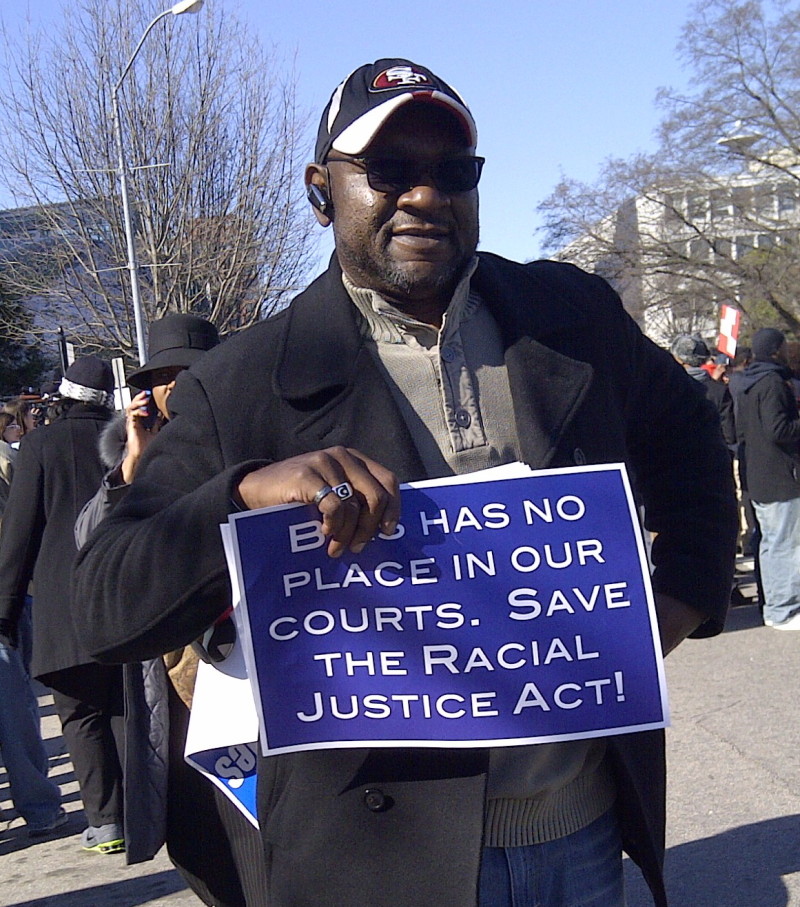
Darryl Hunt wins award for work to end death penalty
CDPL board member Darryl Hunt is this year’s winner of the ACLU’s Paul Green Award for people who have made important efforts to abolish or reform the death penalty.
We cannot imagine a more deserving recipient. Darryl spent 19 years in prison and was nearly sentenced to death for a murder he didn’t commit. He received a sentence of life in prison because a single juror refused to vote for the death penalty.
“If I had gotten a death sentence, there’s no doubt in my mind, I would have been executed,” Darryl says.
Although DNA results proved his innocence in 1994, it took another 10 years of legal appeals to exonerate him. The state fought his release until another man finally came forward and confessed to the crime.
Since his release in 2004, Darryl has devoted his life to advocating nationwide for ending the death penalty. In 2005, he founded the Darryl Hunt Project for Freedom and Justice, a nonprofit organization dedicated to educating the public about criminal justice reform opportunities, advocating for the wrongfully convicted, and supporting people who are recently released from prison. He was a key advocate for the passage in 2009 of the groundbreaking N.C. Racial Justice Act, which allowed death row inmates to challenge their sentences based on evidence of systemic racial bias.
In 2012, Darryl received an honorary doctorate from Duke University for his work. He also joined the CDPL board of directors that year.
Buy tickets here for the April 2 Liberty Awards Dinner honoring Darryl and other civil liberties heroes.
New Hearings Ordered But Findings of Discrimination Stand in Racial Justice Act Cases
For Immediate Release:
December 18, 2015
RALEIGH — Today, the N.C. Supreme Court ordered new hearings in four Racial Justice Act cases because of legal technicalities, but did not overturn the key findings of these groundbreaking cases: that African-Americans have been systematically excluded from serving on capital juries, producing unfair outcomes for defendants on trial for their lives.
The court said the state deserved more time to review the findings of a comprehensive statistical study presented by defendants, which looked at hundreds of capital cases from 1990-2010 and found that prosecutors used peremptory strikes to remove qualified black jurors at more than twice the rate of white jurors. In the second case, where three defendants’ claims were heard jointly, the court also said the three cases should have been heard separately.
The Supreme Court encouraged both sides to present additional statistical studies. The decision will keep executions on hold indefinitely in North Carolina, where the courts have stayed all executions until Racial Justice Act litigation is resolved.
“We are confident that, no matter how many hearings are held or studies completed, we will win this case. The evidence of racial bias in jury selection is simply overwhelming and undeniable,” said Jay Ferguson, attorney for the defendants. “All this decision will do is add more delays and cost the state millions to conduct new studies and hold new hearings. We will be throwing more taxpayer money into a hopelessly broken death penalty.”
The four defendants whose cases were decided today — Marcus Robinson, Quintel Augustine, Christina Walters, and Tilmon Golphin — were all removed from death row and resentenced to life without parole by Superior Court Judge Gregory Weeks in 2012. Weeks wrote in his ruling that he found “a wealth of evidence showing the persistent, pervasive, and distorting role of race in jury selection throughout North Carolina.”
“The powerful evidence that Judge Weeks found still stands,” said Ferguson. “Nothing the Supreme Court did today challenges that in any way. As a state, we cannot ignore this troubling evidence that racial bias infects the death penalty from the very beginning of the process. When we cannot even choose the jury fairly, we surely cannot ensure fair trials and outcomes for defendants facing execution.”
No new death sentences, few capital trials in 2015
As 2015 draws to a close, CDPL has reason to celebrate: There were no new death sentences this year in North Carolina.
In the past five years, no more than three people have been sent to death row in a single year. And in 2012, we had another full year with no death sentences.
This year brought still more signs that the death penalty is dying in North Carolina. 2015 saw only four capital trials. Meanwhile, executions remained on hold for the ninth straight year, and the murder rate remains lower than in years where executions were monthly occurrences.
We have come a long way since the 1990s, when more than two dozen people were sentenced to death each year and the state was executing defendants at a rapid clip. We got here with hard work and persistence.
In 2015, CDPL’s work remained integral to slowing the death penalty’s pace in North Carolina:
- We continued to litigate issues with the state’s lethal injection protocol, which is the main reason executions remain on hold in North Carolina. This year, we defeated the state’s efforts to expedite that litigation and restart executions.
- We also continued to provide substantial assistance to capital defense attorneys, helping to ensure fair outcomes for defendants on trial for their lives.
- We drew enormous public attention to the threat the death penalty poses to innocent defendants, both with our June report on the wrongfully prosecuted and by telling the story of Henry McCollum, a CDPL client who received a pardon of innocence from the governor this year.
- We continued to put a spotlight on race discrimination in jury selection. Evidence from the Racial Justice Act hearings was cited in the national press and in a brief filed in the U.S. Supreme Court as it considered a case with racially-charged prosecution notes that mirrored those of RJA defendant Quintel Augustine. We also published a widely circulated op-ed on the exclusion of African Americans from capital juries.
- Also this year, longtime CDPL client Kenny Neal was resentenced to life imprisonment after 19 years on death row. The court found that Neal could not be executed because of his intellectual disability.
We head for 2016 with optimism that the death penalty will soon be a relic of North Carolina’s past.
On Trial for their Lives: The Hidden Costs of Capital Prosecutions in North Carolina
UPDATE: You can now explore this project as a website and interactive database on its own website, On Trial For Their Lives.
Death penalty advocates say executions are needed to punish a small handful of the “worst of the worst” criminals. However, a new report from the Center for Death Penalty Litigation finds that the death penalty in North Carolina is being used broadly and indiscriminately, with little regard for the strength of the evidence against defendants — and putting innocent people at risk of being sentenced to die.
On Trial for Their Lives: The Hidden Costs of Wrongful Capital Prosecutions in North Carolina is the first study in the United States of cases in which people were charged or prosecuted capitally but never convicted. The study finds that 56 people since 1989 — about two a year — have been capitally prosecuted in North Carolina despite evidence too weak to prove their guilt. The wrongful prosecutions happened in 31 counties in every region of the state.
The report comes on the heels of the exoneration of Henry McCollum, North Carolina’s longest serving death row inmate. It exposes another facet of a capital punishment system that targets innocent people with the death penalty. Considering that only 40 people have been executed in North Carolina in the time period the report covers, more people have faced the death penalty and not been convicted of a crime than have been executed in North Carolina.
“Many say we need the death penalty to punish the very worst offenders for the most heinous crimes, but that is not how the death penalty is being used,” said senior CDPL attorney Ken Rose, who represented McCollum for 20 years. “People are being charged capitally based on the thinnest of evidence. Prosecutors are using the threat of the death penalty to persuade people to plead guilty. If we keep using the death penalty like this, North Carolina will sentence more innocent people to death.”
While it is inevitable that innocent people will occasionally be swept up in investigations, the report finds that the system took years to correct its errors and that shoddy investigations or misconduct were frequently a factor.
These unjust prosecutions had a devastating impact on the lives of the defendants — as well as a large public cost. The report finds that:
- The state spent nearly $2.4 million in defense costs alone to pursue these failed cases capitally. Had the defendants been charged non-capitally, all that money could have been saved. (This conservative figure does not take into account the additional prosecution and incarceration costs in capital cases.)
- Defendants who were wrongfully prosecuted spent an average of two years in jail before they were acquitted by juries or had their charges dismissed by prosecutors.
- The 56 defendants in the study spent a total of 112 years in jail, despite never being convicted of a crime.
- By the time they were cleared of wrongdoing, many defendants lost their homes, jobs, businesses, and savings accounts, and saw personal relationships destroyed. They received no compensation after they were cleared of charges.
- Serious errors or misconduct played a role in many cases. The 56 cases involved instances of witness coercion, hidden evidence, bungled investigations, the use of improper forensic evidence, and highly unreliable witnesses.
Interviews with defendants and attorneys show that North Carolina is using the threat of the death penalty as leverage to encourage defendants to confess or accept plea bargains, a strategy for securing convictions in cases with weak evidence.
“National polls tell us that Americans across the country have become increasingly uncomfortable with the administration of the death penalty in the United States,” said Robert Dunham, executive director of the Death Penalty Information Center, a national non-profit organization that provides analysis and information on issues concerning capital punishment. “This study shows that the misconduct and miscarriages of justices that so frequently occur in capital cases are not limited to cases in which the death penalty is imposed. The types of wrongful capital prosecutions documented in this report can only further undermine public confidence that the death penalty can be administered fairly.”
The 56 cases included in the report represent a conservative estimate of the number of wrongful capital prosecutions during the past 25 years. The state does not track such cases, and researchers did not consider cases in which they could not find adequate information. They also used strict criteria that excluded cases where the defendant was convicted of any lesser offense related to the murder.
CDPL honors defense attorneys with Osborn and Stein Awards

Staples Hughes
CDPL is proud to announce that longtime capital defender Bob Hurley is the recipient of the 2015 J. Kirk Osborn Award, for outstanding work on behalf of indigent clients facing the death penalty. This year, CDPL also presented the first Adam Stein Award for appellate advocacy and work to raise the standard of practice in capital cases. N.C. Appellate Defender Staples Hughes was the recipient of that award. We thank Bob and Staples for decades of important work to save the lives of vulnerable defendants. Learn more about CDPL’s awards here.
In wake of McCollum exoneration, CDPL releases groundbreaking new report
On Trial for their Lives: The Hidden Costs of Wrongful Prosecutions, a new report from the Center for Death Penalty Litigation, finds that the death penalty in North Carolina is being used broadly and indiscriminately, with little regard for the strength of the evidence against defendants — and putting innocent people at risk of being sentenced to die. It is the first study in the United States of cases in which people were charged or prosecuted capitally but never convicted. Its findings shed new light on how innocent people get caught up in the death penalty system.
CDPL client receives pardon of innocence from N.C. governor
CDPL client Henry McCollum has been granted a rare pardon of innocence by Gov. Pat McCrory, and is now eligible for up to $750,000 in compensation for the 30 years he spent on death row. McCollum was N.C.’s longest serving death row inmate when he was exonerated in September 2014. CDPL represented McCollum for 20 years, along with attorneys from the law firm of WilmerHale in Boston, and the N.C. Innocence Inquiry Commission conducted substantial investigation in the case. Read about this tragic case here.
On Trial for Their Lives: The Leslie Lincoln Story
We often hear the death penalty is needed to punish a small handful of the “worst of the worst” criminals. However, research shows the death penalty in North Carolina is used broadly and indiscriminately, with little regard for the strength of the evidence against defendants — a practice that puts innocent people in danger of being executed. Watch Leslie Lincoln’s story of being wrongly tried for her mother’s murder. Learn more about wrongful capital prosecutions and read Leslie’s full story at OnTrialForTheirLives.org.
CDPL attorney wins national prize for defending the condemned
Longtime CDPL attorney Ken Rose has been awarded the National Legal Aid & Defender Association‘s 2015 Kutak-Dodds Prize for his extraordinary commitment to defending indigent clients facing the death penalty. The association says: “Kenneth Rose is honored for his life-time commitment to public defense work for nearly 35 years in Georgia, Mississippi, and North Carolina. Rose has spent his entire career representing low-income clients on death row, many of whom are mentally ill and intellectually disabled. He has played a key role in advocacy efforts to limit the death penalty, helping to enact a North Carolina statute barring the death penalty for persons with intellectual disabilities and another that allowed death row prisoners to present statistical disparities and other evidence to show that race played an impermissible role in their cases.” Rose has also helped to free several innocent men from death row, the most recent of which was Henry McCollum.